EU Persistent Organic Pollutants (POPs) Compliance: Connecting Environmental Protection and Global Supply Chains
By: Bodhi Hale, Director of Environmental Science & Technology with Vanguard Environmental (Tulsa, OK)
Bodhi Hale is the Director of Environmental Science and Technology in Tulsa, where he focuses on the intersection of environmental compliance, applied science, and emerging technologies. His passion for environmental protection was instilled at an early age through exposure to horticulture and land stewardship, shaping a lifelong interest in the complexity and resilience of natural systems.

Environmental compliance often begins with the materials a facility stores, the emissions it generates, and the waste it produces. However, a manufacturer's environmental responsibilities can also follow its products beyond the facility and into international markets. A component produced in the United States may become part of equipment sold overseas, bringing customer expectations that require a closer understanding of its chemical composition. For suppliers, a request for a signed declaration can become the starting point for a much broader review of materials and manufacturing practices.
European Union persistent organic pollutants compliance, commonly referred to as EU Persistent Organic Pollutants (POPs) compliance, illustrates this connection. These requirements address chemicals whose environmental effects can extend well beyond their original use. Understanding their history, regulatory framework, and relevance to manufactured products helps businesses respond to customer requests with meaningful documentation. A recent Vanguard Environmental project for Takako America demonstrates how this work can support an individual customer while establishing a foundation for future compliance services.
Understanding Persistent Organic Pollutants
Persistent organic pollutants are carbon-based chemicals that resist environmental breakdown, can travel considerable distances, accumulate in living organisms, and cause harmful effects. Their persistence allows contamination to remain long after the original release. Movement through air, water, and other environmental pathways can carry these substances into regions where they were never manufactured or used. Consequently, the environmental significance of a POP cannot be assessed solely by looking at conditions near its source.
Bioaccumulation occurs as a substance builds up within an organism over time. Concentrations can also increase through food chains, exposing predators to contamination present in their prey. These characteristics help explain why Persistent Organic Pollutants (POPs) have attracted international attention: their effects connect industrial activities, ecosystems, and human exposure across geographic boundaries. Preventing additional releases requires cooperation among the countries and industries involved in producing, using, and managing these substances.
For manufacturers, this environmental background provides context for a seemingly administrative request. Determining whether a supplied component contains a restricted substance contributes to a broader effort to prevent persistent contamination. The practical challenge is translating that objective into clear questions about materials, suppliers, and the condition of a product when it is shipped.
From the Dirty Dozen to the Stockholm Convention
The Stockholm Convention on Persistent Organic Pollutants was adopted in 2001 and entered into force in 2004. It established an international framework for eliminating or restricting certain intentionally produced Persistent Organic Pollutants (POPs), reducing releases from unintentional production, and managing affected stockpiles and wastes. Its structure recognizes that controlling these pollutants requires attention to both chemical use and the ways pollutants enter the environment.
The Convention initially addressed twelve substances or substance groups, often called the “Dirty Dozen”: aldrin, chlordane, DDT, dieldrin, endrin, heptachlor, hexachlorobenzene, mirex, toxaphene, polychlorinated biphenyls (PCBs), dioxins, and furans. These included pesticides, industrial chemicals, and unintentionally produced by-products. Some appeared in more than one category, reflecting the different ways a pollutant can be produced or used.
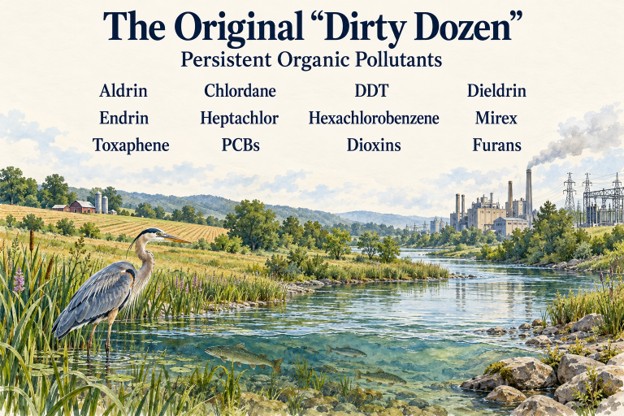
The original list was a starting point. The Convention provides a process for evaluating and adding other substances as scientific evidence develops. Later additions have included certain brominated flame retardants, short-chain chlorinated paraffins, and specific per- and polyfluoroalkyl substances (PFAS), including PFOA and PFHxS and the substances covered by their respective listings. These additions extend the subject beyond historical pesticides into materials associated with modern manufacturing.
For businesses, an evolving list creates an ongoing information challenge. A declaration prepared several years ago may address a different set of substances from the one a customer asks about today. Effective review therefore starts by identifying the applicable requirements and the version of the substance list being evaluated.
How the European Union Regulates Persistent Organic Pollutants (POPs)
The European Union implements its international Persistent Organic Pollutants (POPs) commitments through Regulation (EU) 2019/1021, as amended. The regulation addresses substances on their own, in mixtures, and in manufactured articles. An article is an object whose function depends more on its shape, surface, or design than on its chemical composition. This means a review may extend to finished components as well as chemical products used during manufacturing.
Annex I establishes prohibitions subject to applicable exemptions, including specified conditions for unintentional trace contaminants. There is no single concentration limit that can be applied to every POP or material. A determination must consider the particular substance entry, its scope, the relevant limit, and any conditions or dates attached to an exemption.
The regulation also addresses waste through separate provisions and annexes. Annex IV waste concentration limits should not be substituted for Annex I limits when evaluating a product. These provisions serve different purposes: one concerns materials entering or remaining in use, while the other governs the management of affected waste.
A Stockholm Convention decision and an EU amendment also require separate tracking. Businesses should verify the applicable EU legal text and effective dates rather than assuming that an international listing immediately changes every EU product requirement. Recording the basis and date of each assessment helps keep later reviews understandable.

Why U.S. Suppliers Receive Compliance Requests
A U.S. supplier can encounter EU Persistent Organic Pollutants (POPs) requirements through its customers even when it does not directly export to Europe. For example, a domestic customer may incorporate a purchased component into equipment intended for the EU market. Because EU controls extend to articles placed on that market, information about upstream materials becomes relevant to the customer's assessment of the finished product. This is a practical supply-chain implication of the regulation's product coverage.
The customer's declaration request should be examined carefully. Its wording may ask about specific parts, a defined list of substances, or all products supplied by a company. Those are different commitments. The review should establish exactly what the customer wants confirmed and whether the available documentation supports that statement. A narrow, clearly supported declaration is more useful than a broad assurance that leaves its underlying scope uncertain.
For Takako America, the project arose from Tuff Torq's request concerning supplied parts and the downstream EU market. That distinction matters: the assessment supported a customer documentation requirement and did not establish that Takako America's Kansas facility was itself subject to EU facility permitting. Keeping the market requirement and the project scope clear helped focus the review on the parts and materials relevant to the requested declaration.
Building a Defensible Material Review
A practical assessment begins with a defined list of parts and the records associated with them. Part numbers, material specifications, supplier identities, and manufacturing information should connect each item to the evidence used in its review. A material document has limited value if the reviewer cannot establish which supplied component it describes. Organizing these connections early also makes it easier to identify missing information before a declaration is prepared.
Safety Data Sheets (SDSs) provide useful information about chemical properties, hazards, and safe handling, but they are not automatically complete composition disclosures. Their information requirements serve hazard communication purposes. For Persistent Organic Pollutants (POPs) screening, the practical implication is that absence from an SDS should not, by itself, be treated as proof that a substance is absent from the finished product. Material breakdowns, specifications, and targeted supplier confirmations can help address questions left open by an SDS.
The condition of the shipped part also deserves attention. A review should consider whether coatings, protective oils, or other materials remain on its surface. The base material may be well documented while a surface treatment introduces a separate information need. Conversely, the mere presence of a chemical elsewhere in the facility does not establish that it remains on a supplied part. Process knowledge helps distinguish relevant materials from unrelated inventory.
The final statement should reflect the strength and limits of the evidence. Where supplier records are incomplete, additional information or appropriately targeted testing may be needed. Any unresolved item should remain identified as unresolved. Retaining the supporting records, review date, and scope allows another reviewer to understand how the determination was reached and what would require it to be reconsidered.

Applying the Review at Takako America
Vanguard Environmental recently applied this approach to a Tuff Torq request covering 13 parts supplied by Takako America. I coordinated a document-based review of material breakdowns, specifications, and SDSs to evaluate the requested parts against the applicable EU Persistent Organic Pollutants (POPs) requirements. The work included reviewing materials associated with the parts and considering the rust-preventive oil that remained on shipped components.
Sufficient documentation supported 12 of the 13 parts. No EU Persistent Organic Pollutants (POPs) substances were identified above applicable thresholds in those documented parts. One pin was excluded from the completed declaration because the manufacturer's material breakdown remained unavailable, and no determination was made for that item. The review did not include laboratory testing. The completed declaration was prepared for Takako America's authorization and signature before submission to Tuff Torq.
The project also included an Executive Summary and Findings documenting the scope, supporting information, and remaining limitation. Organizing these records with the applicable regulations and supporting materials created a usable reference for future questions. Just as importantly, the project demonstrated that completing a review includes identifying where the evidence ends and clearly separating an outstanding item from the supported results.
Preparing for Future Compliance Needs
The Takako project provides a practical foundation for similar work with other clients. Vanguard could build on this experience by helping manufacturers organize supplier documentation, evaluate customer declarations, and maintain records connecting parts to their supporting material information. These services would be especially useful when a client receives an unfamiliar request and needs to determine what information to collect before making a commitment to its customer.
A useful intake process would ask clients to provide the customer request, covered part numbers, available material records, and requested response date together. Gathering these items at the outset would help establish realistic expectations, reduce repeated follow-up, and direct attention to the information needed for each assessment.
Future support could also include reassessments following changes in suppliers, formulations, coatings, part designs, or manufacturing processes. A previously reviewed part should not automatically retain the same determination if the information supporting that determination changes. For Takako, obtaining the outstanding pin documentation would provide a specific next step, allowing that part to be assessed separately and the declaration updated if supported.
Maintaining a searchable chemical reference and consistent review procedure could make subsequent projects more efficient. Database screening can help identify potential matches, while technical review remains necessary to evaluate substance groups, concentrations, exemptions, and the completeness of supplier information. Assigning responsibility for regulatory updates would help ensure that repeat assessments use a current basis rather than simply reproducing an earlier result.
EU Persistent Organic Pollutants (POPs) compliance connects a global environmental objective with everyday manufacturing decisions. Businesses strengthen that connection when they understand their materials, communicate clearly with suppliers, and support customer declarations with traceable evidence. Building on the Takako experience offers Vanguard an opportunity to help clients respond to future requests with greater confidence while supporting the prevention of persistent environmental contamination.