Hazard Communication Is Changing: Is Your Facility Ready for OSHA's November 20, 2026 Deadline?
By Mairis Ramos, Director of OSHA Education, Vanguard Environmental, Inc. (Tulsa, Oklahoma)
Bio-sketch: Mairis Ramos serves as Director of OSHA Education for Vanguard Environmental, Inc., supporting industrial facilities with OSHA compliance, employee training, industrial hygiene, noise monitoring, respiratory protection, and Hazard Communication programs.
For many employers, Hazard Communication is one of those OSHA programs that feels familiar because it has been part of everyday workplace safety for decades. Chemical inventories, Safety Data Sheets, container labels, pictograms, written programs, and employee training are already common parts of industrial operations. That familiarity, however, can create a false sense that nothing significant has changed. OSHA's 2024 update to the Hazard Communication Standard, 29 CFR 1910.1200, revised several important requirements and aligned the U.S. system more closely with Revision 7 of the United Nations Globally Harmonized System of Classification and Labelling of Chemicals, commonly called GHS. For employers using hazardous chemicals, one of the most important dates is now approaching: November 20, 2026. By that date, employers must, as necessary, update alternative workplace labels, update their written Hazard Communication Program, and provide additional employee training for newly identified hazards associated with substances.
The November deadline did not appear in the original 2024 rule. On January 15, 2026, OSHA extended the compliance dates by four months to provide additional time for the regulated community to receive and review agency guidance. Under the revised schedule, chemical manufacturers, importers, and distributors evaluating substances were required to comply with the modified provisions by May 19, 2026. Employers then receive an additional transition period through November 20, 2026 to address workplace changes that become necessary as updated hazard information moves downstream. Mixtures follow a later schedule: manufacturers, importers, and distributors have until November 19, 2027, while employers have until May 19, 2028 to make the corresponding workplace updates, as necessary. These are tiered dates, which means a facility may receive revised SDSs and labels gradually rather than all at once.
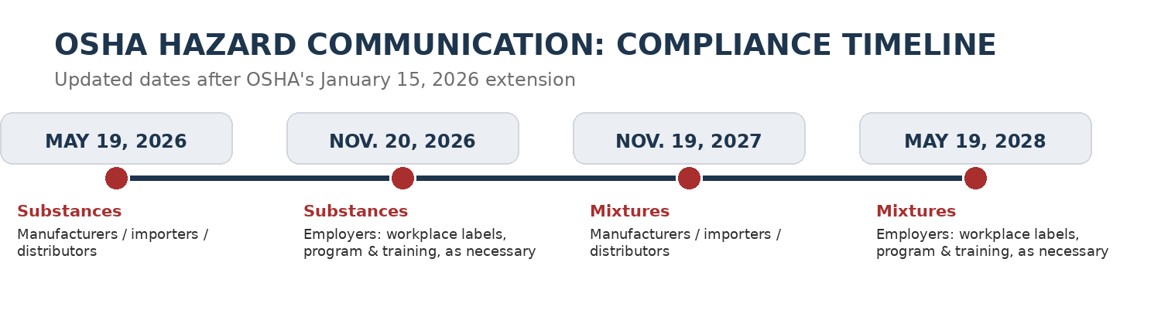
That distinction matters. The 2026 employer deadline is not a requirement to rewrite every Hazard Communication Program or retrain every employee simply because a calendar date has arrived. OSHA's regulatory language says employers must make the changes 'as necessary.' In practice, the trigger is new or modified hazard information received for the substances present at the facility. If an updated SDS identifies a newly classified physical hazard, health hazard, or other hazard covered by the standard, the employer needs to determine whether workplace labels, procedures, written program language, or employee training must change. The safest approach is not to assume that an existing program remains current. Employers should compare incoming SDS revisions with the versions already on file and document the review process.
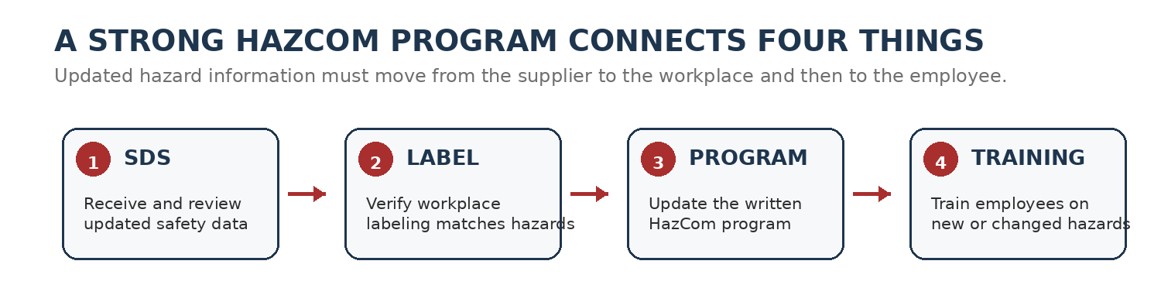
The updated standard does not replace the basic Hazard Communication system. Its core remains the same: manufacturers and importers classify hazards; containers are labeled; SDSs communicate technical information; employers maintain a written program; and employees receive information and training. The 2024 revisions improve how hazards are classified and communicated. OSHA added or revised criteria affecting aerosols, desensitized explosives, and certain flammable gases, and it updated selected hazard and precautionary statements and parts of the SDS requirements. For many end users, the most visible effect will be a revised SDS or shipped-container label. That document should not simply replace the old version in a binder without review because it may change the information employees rely upon to work safely.
One area that deserves special attention is the facility's chemical inventory. A strong inventory should identify what products are present, where they are used, and whether a current SDS is available. During the transition, employers can use the inventory as a control document: when a revised SDS arrives, note the revision date, compare the hazard classifications, and verify that the current copy is accessible. This is also a good time to identify discontinued chemicals, outdated SDSs, duplicate products, or materials that entered the workplace without the normal chemical approval process. Cleaning up the inventory now makes labeling, training, and future HazCom reviews much easier.
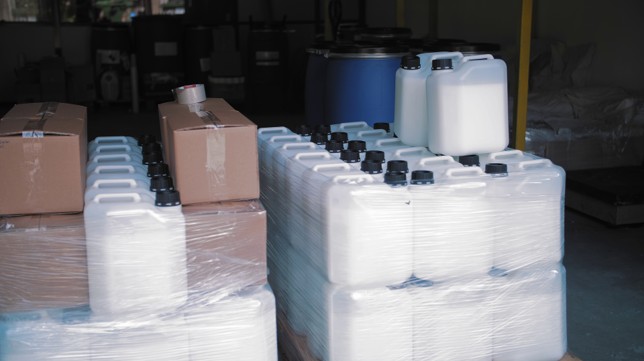
Workplace labeling is another area where small inconsistencies can create larger compliance problems. Under 29 CFR 1910.1200(f)(6), employers may use the full shipped-container label information or an alternative workplace labeling system that identifies the product and communicates general hazard information when more specific information is immediately available to employees through the Hazard Communication Program. Existing labels must remain legible and accessible, and employers may not remove or deface incoming labels unless the container is immediately relabeled with the required information. As updated SDSs arrive, employers should verify that alternative workplace labels still reflect the hazards of the chemical. A label created several years ago may no longer be adequate if the product's hazard classification has changed.
The updated rule also formalizes special labeling provisions for small and very small containers. This issue primarily affects manufacturers, importers, and distributors, but employers should understand the changes because those packages may arrive at their facilities. For certain containers with a capacity of 100 milliliters or less, OSHA permits reduced information on the immediate container when full labeling is infeasible, provided the required information appears on the immediate outer package. For certain containers of 3 milliliters or less, only the product identifier may be required on the container when a label would interfere with normal use and other conditions are met. Employees who unpack, store, or use these products need to know where the complete hazard information can be found and should not discard outer packaging prematurely when it contains required label information.
Safety Data Sheets remain the technical backbone of Hazard Communication. OSHA requires employers to maintain an SDS for each hazardous chemical used in the workplace and to make SDSs readily accessible to employees during their work shifts. The familiar 16-section format remains in place. The revised HCS includes changes intended to improve the quality and consistency of information appearing on SDSs, including information associated with physical properties, hazard classification, and certain concentration ranges claimed as trade secrets. Employers do not need to become chemical classifiers to comply effectively. They do, however, need a reliable process for receiving updated SDSs, recognizing when information has changed, ensuring the current version is accessible, and communicating changes that affect employees. Electronic SDS systems are useful only if workers can actually access them when needed, including during foreseeable emergencies.
Employee training is where a paper-compliant program becomes a functioning safety system. The HCS requires training at initial assignment and whenever a new chemical hazard is introduced that employees have not previously been trained about. During the 2026 transition, a revised SDS may identify a new hazard that affects employees who use the product, work nearby, respond to spills, or perform maintenance. Training should focus on what changed and what employees need to do differently. That may include recognizing a new pictogram or hazard statement, understanding updated PPE expectations, following revised handling or storage precautions, or knowing what to do in an emergency. Training does not need to be complicated, but it must be effective and understandable.
Facilities with multilingual workforces should also review how hazard information is communicated. OSHA requires workplace labels and SDSs to be in English, but employers may provide the information in additional languages as well. More importantly, employee information and training must be presented in a manner workers can understand. A technically correct English-language program is not effective if employees do not understand the hazards or protective measures being explained. Employers should evaluate whether bilingual training, translated supplemental materials, visual aids, demonstrations, or supervisor reinforcement would improve comprehension. This is particularly important when the workforce includes temporary employees, contractors, new hires, or employees who move between departments where different chemicals are used.
A practical readiness review can start with a walk through the facility. Select chemicals from several departments and trace the information from beginning to end. Is the product on the inventory? Is the current SDS available? Is the label legible? Are secondary containers identified? Do employees know the hazards and protective measures? Does the written program describe what the facility actually does? This field verification often reveals gaps that are not obvious during a document review, including unlabeled spray bottles, old SDSs, product names that do not match the SDS, inaccessible electronic SDS systems, or procedures that no longer reflect current operations.
Employers should also distinguish between an SDS update and a meaningful hazard change. Suppliers may revise documents for administrative reasons, formatting changes, updated contact information, or minor technical corrections. Not every revision requires retraining. The review should focus on whether the change affects hazard classification, required protective measures, emergency response, handling, storage, exposure controls, or other information employees need to work safely. A simple documented review log can be useful. Record the product name, previous and new SDS revision dates, whether hazards changed, what workplace documents were affected, whether training was required, who completed the review, and when follow-up actions were closed. This creates a defensible process and helps prevent important updates from disappearing into an SDS database without action.

The approaching deadline is also an opportunity to strengthen the connection between Hazard Communication and other OSHA programs. SDS information often influences PPE selection, respiratory protection evaluations, emergency action planning, spill response procedures, industrial hygiene sampling, and storage practices. A newly identified sensitizer, corrosive hazard, flammability classification, or exposure concern may have implications beyond the HazCom binder. Reviewing updates in isolation can miss those connections. Employers should ask whether new hazard information changes the risk assessment for the task or process, whether engineering or administrative controls should be reviewed, and whether existing PPE remains appropriate. In this way, the HCS update becomes more than a paperwork exercise; it becomes a practical trigger for broader workplace risk management.
For employers wondering where to begin, the priorities are straightforward. First, confirm that the facility has a current chemical inventory and a reliable method for receiving revised SDSs. Second, identify which SDSs have changed and compare the hazard information. Third, update alternative workplace labels and the written Hazard Communication Program when the new information requires it. Fourth, provide additional employee training when workers are affected by a newly identified hazard. Fifth, document the review and retain evidence of completed corrective actions. Facilities that use these steps now will be in a much stronger position before November 20, 2026 and will already have a repeatable process in place for the later mixture deadlines.
OSHA's updated Hazard Communication Standard is not asking employers to abandon the system they already know. It is asking the regulated community to improve the quality, consistency, and flow of chemical hazard information. The companies best prepared for the transition will be those that treat SDSs and labels as active safety tools rather than static documents. With the November 20, 2026 substance deadline approaching, now is the right time to verify that incoming hazard information reaches the people who need it, workplace labels remain accurate, the written program reflects actual practices, and employees understand what has changed. A focused review today can prevent confusion later and, more importantly, can help ensure that workers have the information they need before an exposure or emergency occurs.
Footnotes
- Occupational Safety and Health Administration, “Hazard Communication Standard; Final Rule,” 89 FR 44144 (May 20, 2024).
- Occupational Safety and Health Administration, “Hazard Communication Standard; Extension of Compliance Dates,” 91 FR 1695 (January 15, 2026).
- 29 CFR 1910.1200, Hazard Communication.
- OSHA, “Hazard Communication Standard - Final Rule to Amend the Hazard Communication Standard,” accessed October 2026.